Okay, confession time. Are you ready? Because this is going to get pretty personal, so I want you to be prepared.
You still here?
Okay.
I... love Harry Potter.
Whew. Glad I got that out there. I feel so much better now that it's just out in the world and I can finally breathe free and be my authentic self.

The Boy Who Sassed.
...yeah, okay. So the Pope is Catholic, water is very often wet, and Maggie loves Harry Potter. There are known truths in the universe, and among them are these.
When I was just a wee, doe-eyed youngster and my mom brought home that first book, I got my very first taste of that feeling of loving something so profoundly that it changes the very core of your being. To internalize a story and characters in such a way that your experiences with them begin to color your reactions to other things in the real world. Seriously. I was deathly afraid of spiders for many moons, not because I had an intrinsic phobia of them, but because Ron Weasley (and Alanna of Trebond, but that's a whole other box of talking purple-eyed cats) hated spiders. It was that ingrained in my worldview.
And really, it probably still is. But let's not test that theory. Put the spider away. Please.
Long story short: when my mom brought home Harry Potter and the Sorcerer's Stone, I got thrown headfirst into my first fandom.
Fandom, for the uninitiated, is that obsessive and (crucially) shared enthusiasm that is most often participated in by people who have a deep love of the same intricate, esoteric, or just really cool thing. It's when you love the thing and you think about the thing and you just want to share the thing with other people who love it as passionately and concentratedly as you do. Often it's a word used to describe the shared love of some creative property containing elements of fantasy or science-fiction ('geeky' stuff), but can really be applied to anything at all. Are you a big fan of a particular sports team? Do you tailgate? Post on message boards about your team? Participate in a fantasy league? Congratulations! You're in a fandom.
My early experiences of the Harry Potter fandom were quite limited-- mostly to real-world interactions with my similarly-enthused friends-- as when I was first introduced to the books, I wasn't allowed to use the Internet without an adult's help. And also, the Internet was mostly just that dancing baby from Aly McBeal at that point, I think. Seriously. I don't even think there was Google yet when I first read Harry Potter books 1-3.
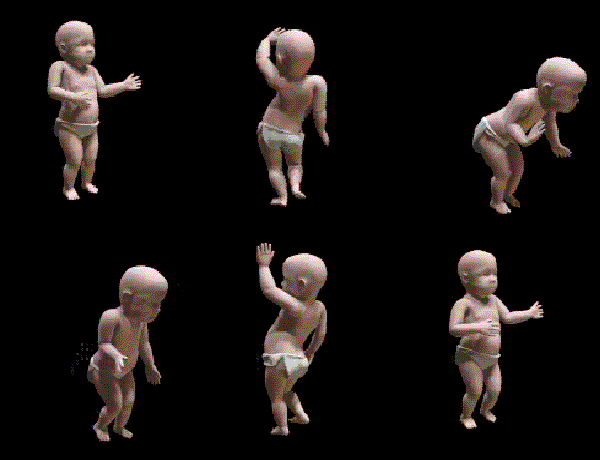
It was a dark time.
But my experience of fandom broadened as the Internet became a more pervasive part of the culture at large. I visited The Leaky Cauldron online. I clicked on every goddamn thing on J.K. Rowling's website (WAY pre-Pottermore, obvs). I discovered fanart and fanfiction. I never really participated much myself in the fandom by way of contributing original works or even chiming in on discussions. I preferred instead to consume what others were saying/creating, but to mostly remain an inactive observer, for reasons I'll get into in a little bit.
(I should say that, though it may have sounded like I was flippantly mocking the sometimes deeply fraught and always intensely personal act of 'coming out' a few paragraphs up, that's really not what I meant. I sort of am coming out here, in a way. I just admitted to loving fanfiction, which is not a thing that I've ever admitted to more than literally two people, ever. Not the same magnitude as coming out of the sexuality closet, of course, but still. That was a big step for me, guys.)
In the intervening years, I have collected more fandoms. Harry Potter is still a very present thing in how I see the world and how I relate to it, but it is now joined by Doctor Who and Sherlock and Supernatural and Whedon and Tolkein... there are more, but (again, for reasons I'll get into) I'm not going to name them all so as not to worry you about my sanity or whatever.
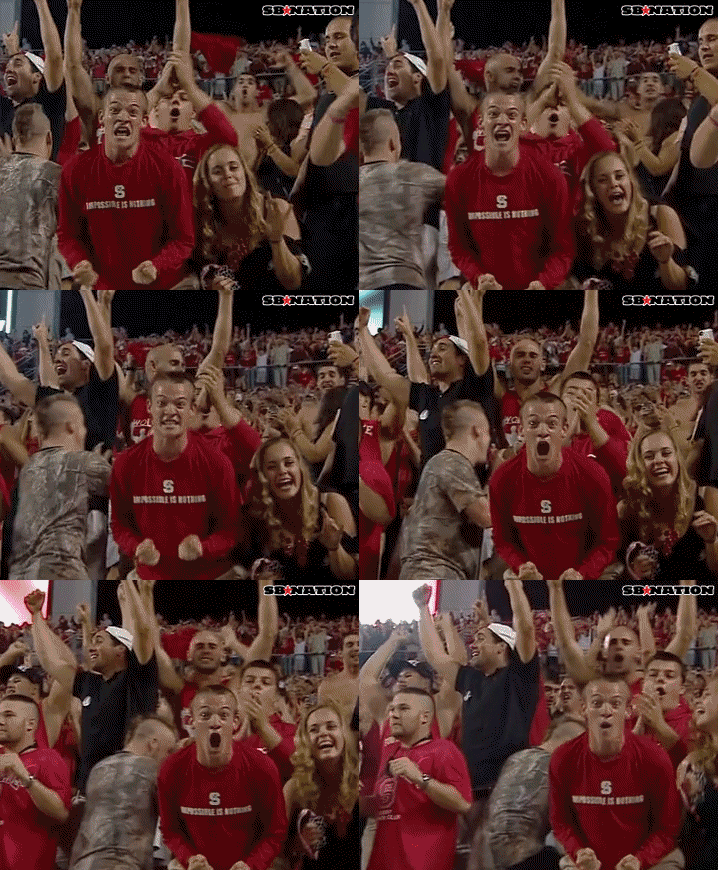
And you really might worry about my sanity if I allowed myself to get truly, authentically as excited as I could get about certain things in these fandoms. For example: the newest series of Doctor Who premiered a little more than a week ago, and there were moments when I had to physically stop myself from like, flailing. Or squeaking in a loud and agitated manner (colloquially termed 'SQEE'ing for perhaps obvious reasons) or rattling off all the call-backs to earlier stories that I recognized because I have definitely watched them a bunch of times before, or creating a new metal band called Peter Capaldi's Attack Eyebrows.

No, sir. All thirteen! (Squee!)
Basically, I had to stop myself from what is called 'fangirling'.
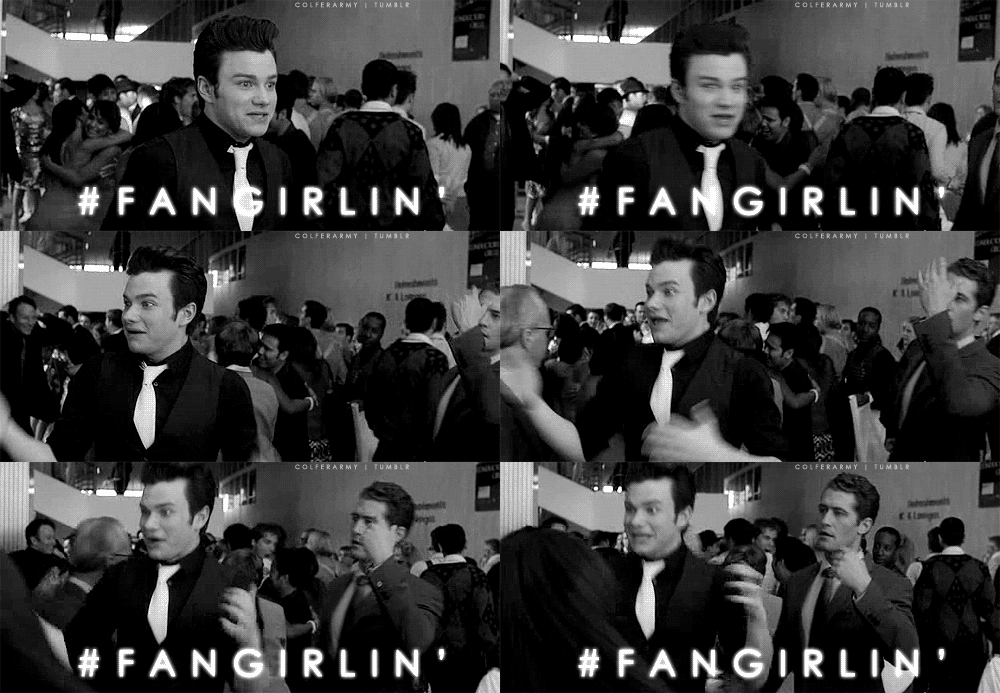
Because I really don't like it when I find myself fangirling.
Urban Dictionary defines the term 'fangirl' thusly:
1. A rabid breed of human female who is obsessed with either a fictional character or an actor. Similar to the breed of fanboy. Fangirls congregate at anime conventions and livejournal. Have been known to glomp, grope, and tackle when encountering said obsessions.
Hugh Jackman: 'ello.
Fangirl: SQUEEEEEE! *immediately attaches to Jackman's leg*
Jackman: Security!
Fangirl: SQUEEEEEE! *immediately attaches to Jackman's leg*
Jackman: Security!
...well. That's... just. Really flattering. I don't know anyone who wouldn't want to be described like that.

Leaving aside the gross and disparaging use of the term 'female' here, and recognizing fully that the entry in this crowd-sourced tool used mostly for looking up weird sex positions may not be entirely serious in intention, it's still not the kind of brush that I (who consider myself fairly level-headed, intelligent, and able to restrain myself from leaping upon an unsuspecting human being like a horny rat terrier) would choose to be painted with.
Because it sounds histrionic. It sounds weird. It sounds animalistic and gross and not really like an identifier that you would give yourself so much as a label foisted upon you as a means of shaming you.
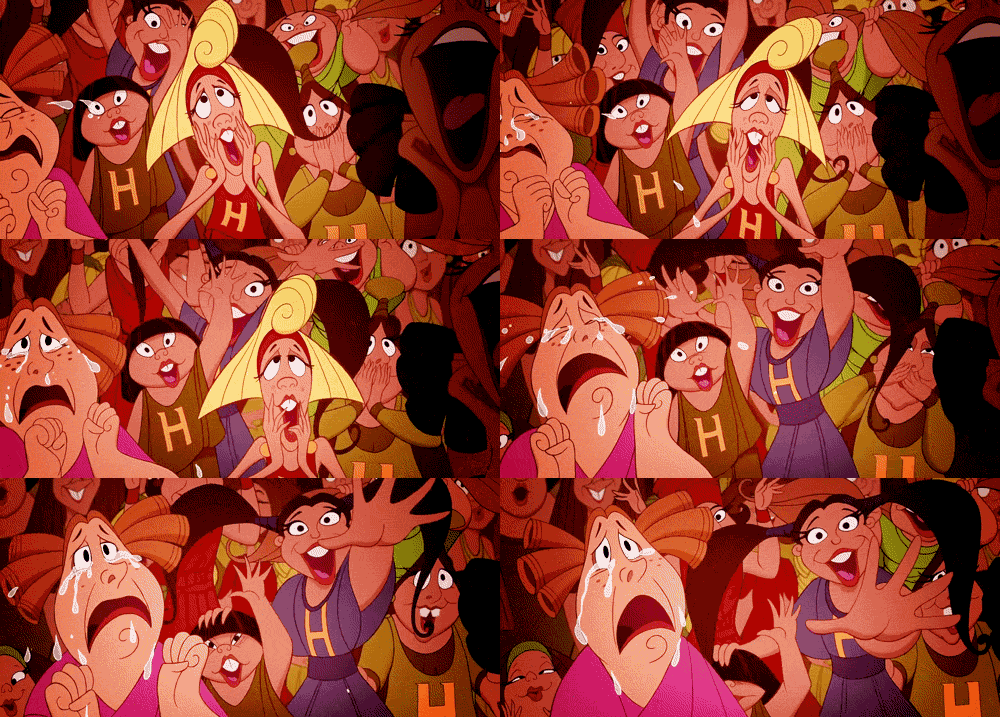
(Fig.1) Aspirational female sexuality.
So, although I am an avowed and very proud nerd about many nerdy things, I try very hard to keep my public 'fangirling' to a minimum. Or even my private fangirling, to be honest. And I really want to examine why I get so weird about this term. I don't find the act particularly distasteful in other people, and realize that the folks who make the entertainment I love do so because they WANT people to love those projects, and that there is nothing at all wrong in expressing your enthusiasm for the things you love in whatever way makes you happy (while also not hurting or endangering yourself or anyone else, obvs).
And despite my personal hangups about the term, 'fangirl' is an identity that many incredibly smart, funny, creative humans voluntarily embrace, as why should they not? Fan culture is wonderful, fandom is life-giving and life-supporting for so many people, and bonding over shared nerdy cultural touchstones has given me the very best and lasting friendships of my life. So why do I get so weird and cringe-y about this particular mode of enthusiasm-expression?
The answer is undoubtedly and frustratingly gendered, since the hysterical, crying fangirl is a fairly pat and overused derogatory trope that has been deployed in cultural commentary about everything from The Beatles to Disney movies to old magazine stories from the 1800s, and is pretty unambiguously yet another way in which women are meant to feel bad about our emotions, our (benign) obsessions, our desires both sexual and social.

Fandoms in the age of AO3, Pinterest, and Tumblr (among many, many other platforms) tend to be woman-led and woman-centric spaces*. This is not an absolute statement, and there are fascinating observations to be made about the differences in how people of different 'races', gender identities, and socializations perform the act of being a fan of something, but it is pretty fair to say that online fandom is often a woman-led space. In this space, women find communities of people with whom they share this important love or passion, and are not only allowed but encouraged to explore enthusiasms and obsessions that would be considered too 'emotional' in other settings. Fandom is a place-- one of the few places in public discourse-- where a woman can go to get even her most unseemly and unruly feelings both validated and celebrated.
(* Note: as with any generalization, this one ignores the complexity of intersectional politics that are entirely essential to comprehensive cultural criticism. I simply don't have the research available right now to inclusively discuss all issues of 'race', ability, sexuality, cisnormativity, age, etc. but know that I'm very aware that I've just used a pretty big paintbrush. I'm working on it.)
One of the ways that women are often shut up and disenfranchised in other parts of public discourse is through the delightful old chestnut about being 'too emotional'. Seriously, the number of ways in which dudes (and others) use this perceived ideal of femininity to discredit and keep women from talking is mind-boggling to think about. "I can't talk to you when you're like this..." "Calm down..." "Are you on your period?" "Must be that time of the month, huh? Heh heh heh..." Fandom is a fascinating subversion of this typically male-dominated mode of discourse, wherein feelings are not a weakness, but are central to the discursive paradigm. So much so that there's even very common slang for it: "so many feels!"
There's also the fact that fandom is unabashedly sex-positive, on the whole. Fantasies of gender subversion, gender ambiguity, kink, anything-other-than-heterosexual-missionary-style-bangin' are all enthusiastically explored through fanfiction, and this is probably one of the reasons fandom in general has such a strange stigma attached to it. Because I ain't gonna lie: there's some weird shit out there, y'all.
But the fact is that that weird shit exists to be explored. To be discussed and revised and challenged and improved. In a world where slut-shaming is still absolutely the mediated norm, in a world where a woman claiming sexual subjecthood for herself is broadly fetishized and (despite our collective blase narrative about the tiny portion of human sexuality that is ever represented for us in the media as desirable) we still do a hell of a lot of pearl-clutching about a whole lot of body stuff, to find a place in which sex (or asexuality! and romance! or aromance! or demi-grey-other identifiers!) in all its complexity is allowed to play out in hypothetical imaginings within the bounds of alternate universes where homophobia doesn't exist, where gender is commonly recognized to be a mutable and malleable construct, where soul mates exist... fandom is a place where women can talk about sex enthusiastically and unashamedly.
Here, you know what? Just... read this (from the article linked here):
"Do you ever wonder why there’s such a shameful stigma surrounding fan fiction? If I learn to play the guitar by pinging out classics from the Eagles, no one judges me. If famous artists cover classic recordings, no one even blinks. It’s completely socially acceptable to play around artistically in the sandboxes created by musicians — but when we do the same thing with the art of storytelling, we’re branded as a bunch of weirdos.
I think the reason is twofold: Fan fiction is a female-dominated dimension, and fan fiction is a sex-positive space. The world has been trivializing women and shaming them for their desires for forever, and so of course society is going to ridicule a hobby where women are working out their sexuality and gender, and exploring a million ideas about the intersection of those things, and being encouraged by other women to not settle in relationships or settle in the sack. Fan fiction is a lust-filled town along the path to freedom where millions of sexually-satisfied women have gathered to break the chains of the patriarchy."
So why does it freak me out so to have my actions associated with this identifier? Because, while the feminist scholar part of me is 100% here for women-led spaces where sex, gender, and desire can be discussed enthusiastically and creatively, the part of me that grew up a girl in a society that stigmatizes both emotionally expressive women and women enthusiastically exploring non-sanctioned sexualities, I FIND IT SUPER WEIRD AND OMG PLEASE DON'T THINK I'M JUST A SILLY HYSTERICAL FEMALE! I'M REALLY SMART AND I PROMISE I WON'T HUMP YOUR LEG!
(It's also telling that, while I was poking around on the Internets while writing this, the videos about 'fangirls' on YouTube are almost all by male YouTubers performing a grotesque version of common fangirl reactions. They are wearing raggedy wigs and ill-fitting clothing, too much or uglifying makeup and basically treating the idea of emotional women with sexual agency with deep horror and disgust. And in almost all the descriptions of these videos, there is some form of the sentiment "Don't get offended at this super offensive mockery, woman. Jesus, don't take it so seriously. We're just joking around, god." Charming.)

The description of THIS video says "A fangirl got in. Shoot her. SHOOT HER!"
Yay #jokes.
But yes, there is certainly a bit of internalized misogyny going on in my aversion to the typical definition of 'fangirl', but I also think there's more to it than that. Because there's a difference (to me) in being a super-enthusiastic obsessive fan of a creative property, and being a super-enthusiastic obsessive fan of an actual human person.
As an introvert (and yes, Virginia, I AM an introvert) and as someone who would like to be well-respected but who has no ambition towards FAME as it is practiced in the global media, the idea of making another person-- a stranger whom I will likely never meet-- into the object of my fandom feels weird. It's a personal thing, and I realize that this, too, is a perfectly valid expression of admiration for the work and opinions of someone you admire. If they also happen to be really, really ridiculously good-looking, there should be nothing wrong with acknowledging that, either.
But for me, personally, I find it sort of awkward to get really super invested in the artist who portrays a character I love. Or the writer who writes them. I just think about how profoundly uncomfortable I would be if put in a similar situation, and transfer my resultant feelings onto that stranger I admire. It makes me want no part of participating in making that person feel as uncomfortable as I would be in their shoes.
This is also probably dumb, because these people almost always became famous on purpose, through the careers and projects that they chose. But I can't help it; I feel weird about obsessing over a particular, discrete human being (though this doesn't stop me from doing it on the DL.)
Because that is what they are: human beings.
We live in a world where the images of famous people are commodities in themselves. Think about it: when you were a kid, did you or someone you knew have a lunchbox, a backpack, a pencil case, a folder, emblazoned with the image of some band/musician/actor? I personally remember Britney Spears and Hanson adorning school supplies (but not mine because I got PRACTICAL (mostly plain) folders... thanks Mom!) I know that there was a huge industry built up around Zac Efron and Vanessa Hudgens when High School Musical was big, and I worked in a high school during a time when it was not uncommon to see One Direction staring cheerily out at you from the backpacks of girls who were wearing them "ironically" (usually).

RIP Zayn.
We (people) buy gossip magazines and tabloids in no small part because of papped photos of celebrities doing stuff that is "just like us!" like taking out the trash in gross sweatpants, eating unattractively at a restaurant, gaining unwanted weight... and yet, though we would not necessarily want other people scrutinizing US with such glee when in these less-than-"ideal" (sigh) circumstances, our society has somehow allowed the viewing public to exist inside a paradox wherein we can delight that celebrities are "just like us!" while at the same time feeling no compunction about the way in which we violate their privacy in order to obtain this reassurance. We would not tolerate such invasion, and yet we expect these people to do so simply because of their professional notoriety.
But paparazzi photos are a pretty easy violation to recognize and repudiate. Celebrities speak out about these privacy violations all the time, and we have real and tragic evidence that the rabid, predatory demand for such "product" can have deadly and disastrous consequences. Being in London right now, I can tell you that Princess Diana is not an uncommon reference point in casual conversation, even so many years after her death. There is growing activism in certain quarters from famous people who wish their children's privacy be respected, and campaigns to boycott magazines that take pictures of their children without consent. The word 'paparazzi' has gained the connotation of harrying, annoying, opportunistic.
This is not where fandom of a particular person gets uncomfortable for me.
You could argue, quite rightly, that a part of a celebrity's job is appearing in magazines, giving interviews, playing flip cup on Fallon, walking red carpets, and if people want to consume all of that media then it should be perfectly acceptable for them to do so. And you would be right! Clearly, in the service of creating a public persona that will help them succeed in the projects they choose, famous people consensually allow the public into certain aspects of their lives, and that's perfectly fine. It's even the way the system of celebrity is designed. And if you happen to have a scrapbook of every public interview and photo shoot that Harrison Ford has ever done, well. More power to you!

I personally don't get the earring, but hey. You're Han freaking Solo.
Earring it up if you want to, man.
The part where it gets shady for me is in that in-between area where the fan obsession with a particular individual disrupts that person's life or work in a way that they have not consented to. When Tom Hiddleston goes on Graham Norton and is asked to answer for fairly graphic Loki fanart that depicts his naked body. Or really any fanart of a particular person's real likeness (even if the art purports to represent the character) in sexually- or otherwise-explicit scenarios that are not based on any real creative properties in which the person has consentingly participated.
And this is a very grey area, because (if you'll recall above) I was just extolling the virtues of fandom (writing) as a sex-positive space where women are allowed to explore desire with little fear of slut-shaming and much celebration of the infinitely complex variations of sexual acts that can be performed by human bodies. Yay! Good! Smut it up, y'all. But... there is something about spending that much time thinking about and creating visual approximations of another person's physical body in explicit contexts without their knowledge or consent that seems... violating.
And it gets even tricker, because part of the reason this creeps me right out the door is that I have seen the men (it's almost always men) about whom these visual representations are created being made to explain them in public by talk show hosts (and others), who seem to delight in bringing out just the filthiest, most bizarre shit they can find (regardless of the talent of the artist in question, and honestly? Most of the stuff that makes it in these situations is really, really skillfully rendered) in the hopes of getting laughs. And Tom, or Dan, or Chris, etc. has to sit there and blush and grin and be charmingly mortified, and all the while I'm sitting there... well, if we're honest, I've already turned off the interview because I feel so... eugh... for him.
Real talk, Levine.
But. BUT. The laughs are almost never at the expense of the dude, himself. He gets to sit there and (although it probably is really uncomfortable to know that another anonymous human has been thinking about your ass in such vivid detail) reap the benefits of the metanarrative that paints him as so hugely desirable that crazy people (women) come up with just the strangest ways of dealing with their uncontrollable attraction to him. He still comes out looking like a stud, professionally, even if it's personally really uncomfortable.
Instead, the laughs gotten from this act of show n' tell seem to be yet another act of silencing and shaming the women who participate in such acts of fandom, because the media (and sometimes/often the rest of us, thanks to it) still has a deep horror of women with libidos and sexualities that do not conform to the minutely narrow definition of what is deemed acceptable to keep those women from fully and proudly inhabiting that "lust-filled town along the path to freedom where millions of sexually-satisfied women have gathered to break the chains of the patriarchy."
Is there a way to reconcile the seemingly irreconcilable opposition between allowing fangirls to express lust and desire without being shamed into silence and a closeting of their unruly (in the best sense) libidos (certainly a feminist endeavor) and not implicating real, breathing human beings in graphically-depicted sexual/otherwise explicit material without their consent (also certainly a feminist endeavor)?
I really have no idea.
But I do know that, even leaving aside the weird shamey-fake-but-real-embarassment stuff that happens on talk shows or in other places where celebrities are made to answer for the explicit creations of their personal fandom, there are ways of performing fandom inappropriately that have nothing to do with systematic oppression of female sexuality and everything to do with just not being an asshole to someone whose work (or face/abs/butt, sure) you admire.
For instance: in the situation that first led me down this particular weird rabbit hole, when Benedict Cumberbatch stars in a production of Hamlet at The Barbican and has to actually tell people (mostly women, fangirls who sometimes adopt the title "Cumberbitches" even though the dude has expressed real discomfort with the term) not to take pictures of him during the fucking play and the theater has to institute a curfew because of the bedlam caused by stage-door fans late at night when it's over.
Now, do NOT mistake me. I recently shelled out about 70 quid for the opportunity to go see this production. I'm posting this blog entry on the night in question, so if you're reading this on October 1st, then there's a pretty good likelihood that I'm gazing enraptured at the man himself as he acts out what is definitely one of my top three favorite Shakespeare plays. I may very likely cry. I will absolutely be grinning like an idiot, and if I don't actually swoon like a damn Victorian, it won't be because that was totally out of the realm of possibility.

Me, probably.
What I will NOT be doing (although I may have to pop a Xanax to stop myself... what can I say? The dude has a pretty face. He's got a voice like a jaguar hiding in a cello. He's a really, REALLY good actor.) is fangirling.
And now I will explain why. Mostly for myself, but if you've read this far, you might as well follow along.
I guess it all comes down to respect, right? Because there are definitely venues in which and people for whom it would be absolutely appropriate to have a crazy, screaming, totally authentic fangirl moment. It would be in the spirit of a boy band concert, for instance. It is part of the fun of communal movie screenings, midnight showings, etc. If you're going to go stand out in the [insert specific inclement adjective here] weather to attend a rope line at a premiere, go freaking nuts. Because all of that is part of the experience, and is a relational dynamic entered into with full understanding by everyone involved: fans and... fan-ed?
Anyway.
But there are spaces where that's just not okay. Like, for example: a production of William Shakespeare's arguably greatest and indisputably most well-known tragedy put up by one of the preeminent performing arts centers in the world.
I think (in part) because we are always sort of inundated with the commodification of celebrity images through merchandising and media, we seriously fail to imagine them complexly sometimes. All you have to do is go watch "Celebrities Read Mean Tweets" to realize that people can be seriously shitty to other people because the nature of their job has allowed us to dehumanize them and make them into just another consumable good.

(Yes, given a choice between this and other horrifying ways that we dehumanize each other, it doesn't seem like a bad deal... but why does anybody have to get dehumanized in the first place? Can't we all just humanize each other and work on... delousing puppydogs or detailing yummy cookie decorations? Gawd.)
So, in the case of this play that I'm going to see, it kind of sucks that even admiration and enthusiasm (rather than the antipathy and desire for a cheap joke evident in most of the tweets in the Kimmel clip) can end up being seriously disrespectful to the person you say you admire.
Like, if you were a wedding cake designer and had worked really hard and took great pride in the cake you made for this one couple, and then they came in and instead of taking the wedding cake to their venue and letting all their friends and family admire your hard work and express their appreciation that way, they just hugged the cake. And smushed it all over the place and made a big goddamn mess that no one would ever appreciate how you'd intended them to. Even though their enthusiasm would be a compliment to your work, you'd still be pretty pissed off about that wasted effort, right?
Hamlet is an incredibly complex play, with so many ways to interpret the text. The title role is enormous, and I'd imagine that preparing for it (emotionally, performatively, and intellectually) has to be a labor of love, given the magnitude.

Yes, I do like Shakespeare quite a bit. Why do you ask?
And also, Hamlet's a freaking emo kid. He's pensive and thoughtful and complicated, and there is as much going on in the silent moments between his lengthy declamations as there is in the words themselves. Having me screaming "I LOVE YOU SHERLOCK" in the midst of a bravura bit of silent physical acting is probably not going to be taken as a compliment, even if my sentiment is entirely sincere.
You know what? I just realized that I've already gone off on a public Internet screed about allowing art to be sacred and not needing to insinuate yourself into the great moments of human achievement. And (hilariously and coincidentally enough) I made a Hamlet reference in the title of that blog post from 2009. I stand by most of what I said, so... yeah. No need to beat that dead horse anymore, I guess.
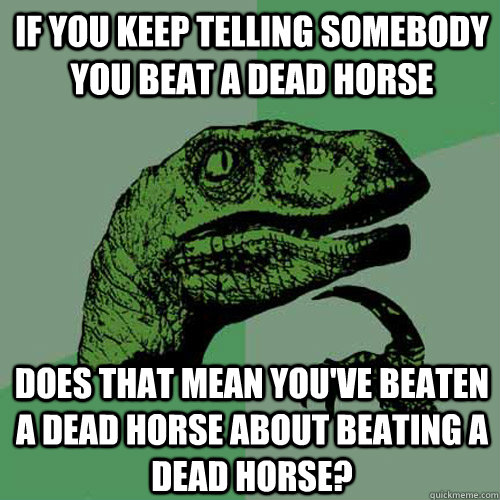
Way meta, Philosoraptor. Way meta.
Here's the thing: fandom is wonderful. The creative properties that inspire fandom and the people who produce them are wonderful. Anything that inspires human beings to use our astounding capacity to create things has got my (un)equivocal seal of approval. If you write My Little Pony fanfiction and share it with your friend on Tumblr because she's having a bad day, you've brightened someone's life, and that is a thing we should all spend more time doing. If the thing that inspires you to sit down and spend some time with yourself just getting lost in the healing act of art happens to be Tyler Oakley's face, just go for it. Art in all its permutations is a human ability that should be celebrated more. I believe this as one of the fundamental threads of my being.
We just have to make sure that, in creating things that make us happy, that make other people happy, that are beautiful for their own sake... in using art to challenge oppressive standards or to embrace marginalized identities, that we are not problematically inhibiting other people from doing the same.
Which is why, when I'm sitting and watching what a friend who should know recently called "one of the great interpretations of our generation" of a play that I love by an actor whom I admire profoundly, I will not be fangirling. That doesn't mean that I won't feel deeply, that I may not have a breathless moment at seeing this guy in the same room as the one I am actually physically in, but that I will attempt to express my admiration and appreciation in a way that will not inhibit the art that I am there to consume from being created in the way it was intended to be seen.
But, let's be real: if I write the follow-up to this treatise once I've seen the play and am safely back the appropriate venue, just be prepared for this:
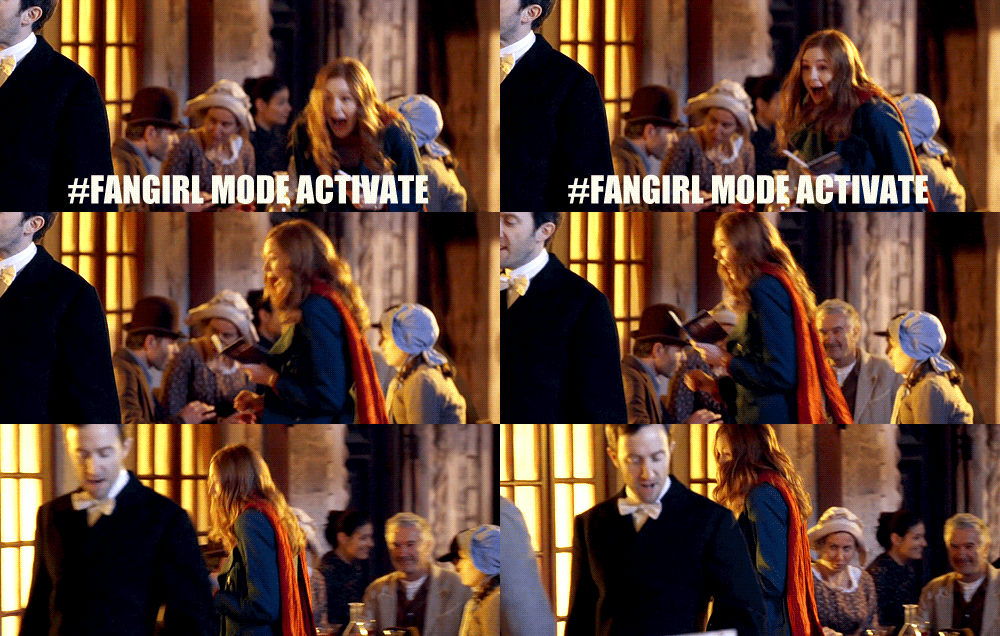
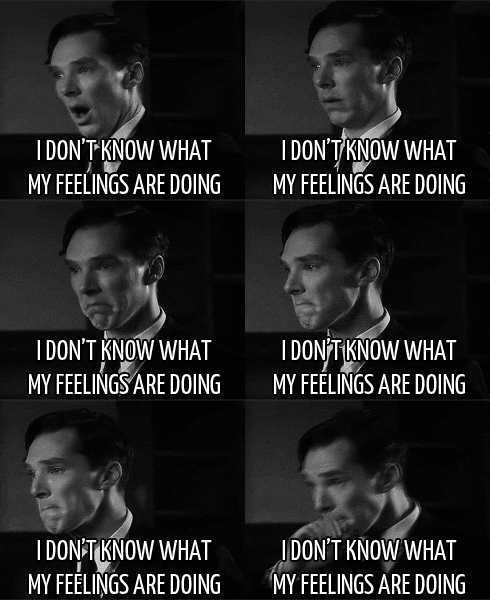






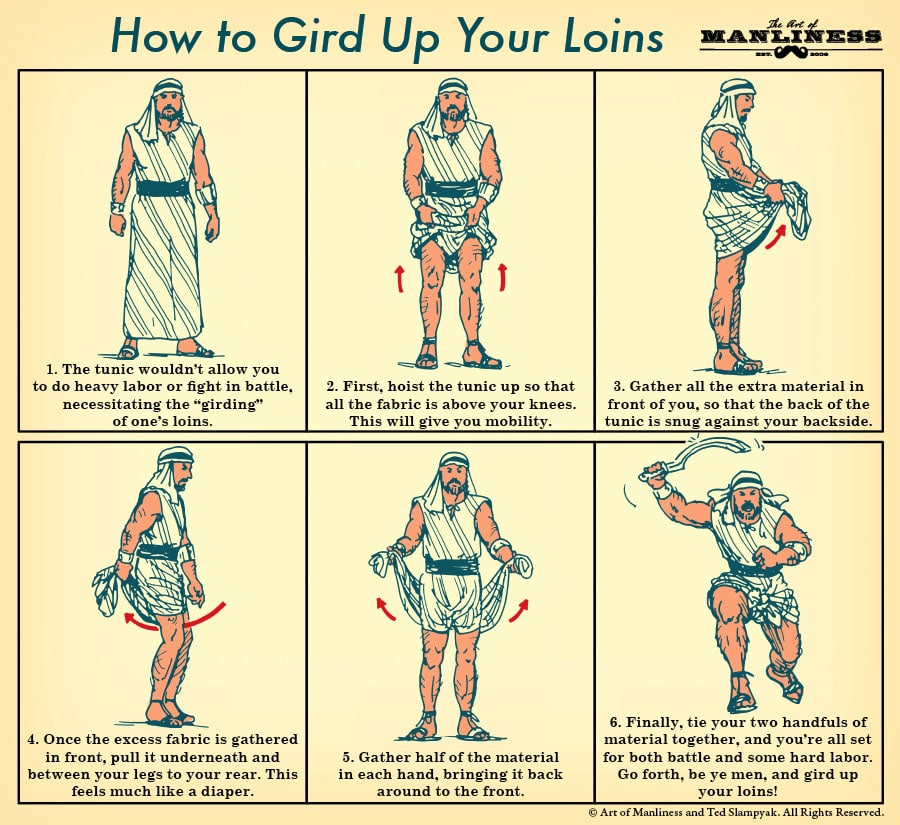
Gird your damn loins, people.
It's happening.

No comments:
Post a Comment